धीरे-धीरे पढ़ें
Devil's work: the legend of the aqueduct of Segovia
In the Spanish city of Segovia, the famous ancient aqueduct is surrounded by a fascinating legend. Although history tells us that this magnificent structure was created by the Romans, local folklore has a much more mysterious explanation.
Stella Donovan
रचनाकार
याद रखें
नीचे पूरी रचना पढ़ें और अपने लिए उपयोगी बात चुनें।
अनुभाग
सकारात्मक विचार
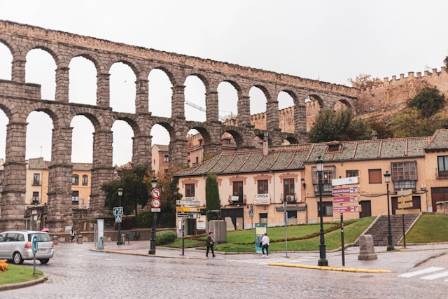
In the Spanish city of Segovia, the famous ancient aqueduct is surrounded by a fascinating legend. Although history tells us that this magnificent structure was created by the Romans, local folklore has a much more mysterious explanation.
According to the popular tale, the impressive monument that overlooks the city was not built by human hands, but by the Devil himself. The story claims that he completed the entire aqueduct in just one night as part of a deal to claim the soul of a young woman.
More than two thousand years later, this unusual legend continues to capture the imagination of visitors and locals alike.
The Story Behind the Devil’s Aqueduct
Long ago, there was a city located at the foot of the mountains where a young woman lived. Every day, she had to walk more than 16 kilometers to collect water from a distant spring.
The journey was exhausting, especially because Segovia is known for its many hills and steep streets. Carrying a heavy water container through the difficult terrain became too much for her. One day, overwhelmed by frustration, she cried out that she would give her soul to the Devil if he could bring water directly to her home.
The Devil soon appeared before her and offered a bargain. He promised to build an aqueduct that would carry water to the entire city, but only if he could complete the enormous task within a single night. If he succeeded before sunrise, the girl would belong to him.
The Devil Begins His Work
After making the agreement, the Devil immediately started construction. According to the legend, thousands of small demons worked alongside him, moving and placing massive stones without stopping.
A powerful storm swept across the area during the night, providing the workers with all the materials they needed. The storm was also said to have created the nearby Siete Picos mountain range, known for its distinctive shape.
With the stones prepared, the Devil and his helpers continued building throughout the night, racing against the coming sunrise.
The Girl’s Prayer Saves Her Soul
As the construction continued, the young woman began to regret her decision. She realized that she had acted out of impatience and laziness, and she no longer wanted to lose her soul.
Filled with guilt, she prayed continuously and asked the Virgin Mary for help. According to the story, her prayers were answered, and the Virgin Mary caused the sun to rise earlier than expected.
When daylight arrived, the Devil had almost completed his work, but one final stone was still missing. That single unfinished detail prevented him from winning the agreement.
The young woman remained alive, Segovia received its magnificent aqueduct, and the Devil fled the city, leaving only his footprints behind.
The Aqueduct’s True History
Although the legend remains deeply connected to Segovia’s identity, the real history of the monument tells another remarkable story.
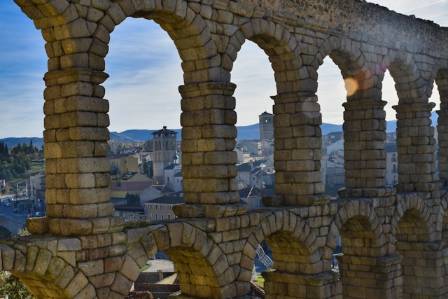
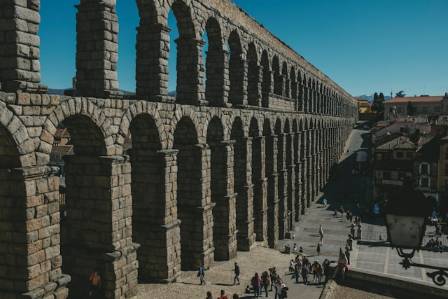
The aqueduct was actually built by the Romans as part of their advanced engineering system. Standing around 30 meters high and featuring 167 arches, it stretches for approximately 16 kilometers from the mountains to the city.
The structure transported water from the Fuenfría spring, the source that supplied Segovia for centuries. Built from carefully placed granite blocks without mortar, the aqueduct demonstrates the extraordinary skill and precision of Roman builders.
Its impressive construction is so remarkable that it is easy to understand why ancient legends imagined a supernatural creator behind it.
How Segovia Celebrates the Devil’s Legend Today
The story of the Devil and the aqueduct remains alive in the cultural memory of Segovia. Generations have continued sharing the tale, even though the true creators were the engineers and workers of the Roman Empire.
Today, locals celebrate this famous legend through art and public displays. A sculpture created by José Antonio Abella portrays the Devil standing on San Juan Street, one of the city’s steep historic roads.
Visitors can see the mischievous character posing proudly with his “creation” and take photographs beside both the sculpture and the magnificent aqueduct.
Whether viewed as an achievement of Roman engineering or a masterpiece of mythical craftsmanship, the Aqueduct of Segovia remains one of Spain’s most unforgettable landmarks.
अगला सहारा
Kopsia Plant Care Guide
Delilah Knox

अपने स्कार्फ को अपनी अलमारी के साथ मैच करने की कला
कुसुम लांबा

कैमरे में कैद किए गए सबसे खूबसूरत सूर्यास्त
खुशी
शूटिंग सितारों का विज्ञान
ली बिलिंग्स

Log Cabin Living Room Ideas
Freya Knight

9 कारण क्यों (सही मात्रा में) कॉफी आपके लिए अच्छी है
वाणी