← मुख्य पन्ना4 मिनट का पाठ
धीरे-धीरे पढ़ें
The 10 Brightest Stars in the Night Sky
The most luminous stars visible from Earth have long fascinated stargazers. Certain stars shine brightly due to their proximity to our solar system, while others appear brilliant because of their immense size and extreme temperatures, which produce vast amounts of light. Still others may seem faint due to distance or advanced age. Although a star’s age cannot be determined by sight alone, we can measure its brightness to uncover deeper astronomical insights.
M
Matthew Taylor
रचनाकार
याद रखें
नीचे पूरी रचना पढ़ें और अपने लिए उपयोगी बात चुनें।
अनुभाग
सकारात्मक विचार
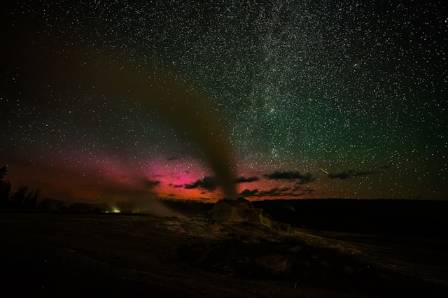
The most luminous stars visible from Earth have long fascinated stargazers. Certain stars shine brightly due to their proximity to our solar system, while others appear brilliant because of their immense size and extreme temperatures, which produce vast amounts of light. Still others may seem faint due to distance or advanced age. Although a star’s age cannot be determined by sight alone, we can measure its brightness to uncover deeper astronomical insights.
Stars are enormous, glowing spheres of hot gas found throughout the universe. They were among the earliest structures to emerge in the cosmos and continue to form in galaxies like our own Milky Way. Our Sun is the closest star to Earth.
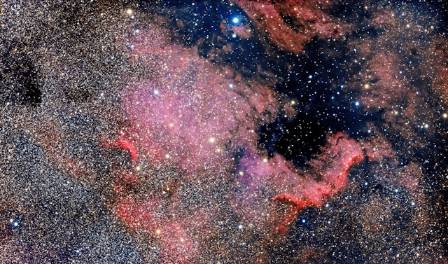
All stars consist mainly of hydrogen, with lesser amounts of helium and minute quantities of heavier elements. Every star visible to the unaided eye is part of the Milky Way, the vast galaxy that includes our solar system. This galaxy contains hundreds of billions of stars, star clusters, and nebulae—clouds of gas and dust where new stars are born.
Below are the ten brightest stars in the night sky, all of which can be observed even from locations with moderate light pollution.
Sirius
Sirius, often referred to as the Dog Star, is the brightest star in the night sky. Its name derives from a Greek term meaning “scorching.” Various ancient cultures incorporated Sirius into their mythology and rituals.
This star is actually a binary system, composed of a very luminous primary star and a fainter companion. Visible from late August through March, Sirius is located 8.6 light-years from Earth. Astronomers classify it as an A1Vm-type star based on its temperature and spectral properties.
Canopus
Canopus is the second brightest star in the sky. Its name may refer to an ancient Egyptian city or the mythological navigator of a Spartan king. Primarily visible from the Southern Hemisphere, it can occasionally be spotted from the southern reaches of the Northern Hemisphere.
Lying 74 light-years away, Canopus is part of the constellation Carina. It is categorized as a type F star, indicating that it is hotter and more massive than the Sun, and also older.
Rigel Kentaurus
Also known as Alpha Centauri, Rigel Kentaurus ranks as the third brightest star. Its name comes from an Arabic phrase meaning “foot of the centaur.” First-time observers in the Southern Hemisphere often seek out this stellar system.
Rigel Kentaurus is a triple star system, with three stars orbiting one another in a complex gravitational dance. It lies just 4.3 light-years away and belongs to the constellation Centaurus. With a classification of G2V, it is quite similar to the Sun in type and evolutionary stage.
Arcturus
Arcturus is the brightest star in the constellation Boötes. Its name means “Guardian of the Bear” in ancient Greek. A popular memory aid uses the curve of the Big Dipper’s handle to “arc to Arcturus.”
This star, the fourth brightest in the sky, is located approximately 34 light-years from the Sun. It is classified as a K5-type star, which means it is somewhat cooler and older than our Sun.
Vega
Vega is the fifth brightest star in the night sky. Its name originates from an Arabic term meaning “swooping eagle.” Situated about 25 light-years from Earth, Vega is a type A star—hotter and younger than the Sun.
Astronomers have detected a debris disk around Vega that may contain planets. It is part of the constellation Lyra and also forms one vertex of the Summer Triangle, a prominent star pattern visible in the Northern Hemisphere from summer through autumn.
Capella
Capella is the sixth brightest star. Its name is Latin for “little she-goat,” and it was documented in many ancient cultures.
This yellow giant star is similar to the Sun but significantly larger. Classified as type G5, it lies 41 light-years away. Capella is the brightest star in the constellation Auriga and forms part of an asterism known as the Winter Hexagon.
Rigel
Rigel is the seventh brightest star, despite being located about 860 light-years away. Its intense luminosity makes it clearly visible. The name Rigel comes from the Arabic word for “foot,” as it marks one of the feet of the constellation Orion.
Classified as a type B8 star, Rigel is part of a four-star system. It is visible from October to March and is also included in the Winter Hexagon.
Procyon
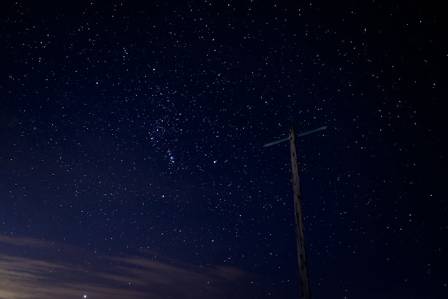
Procyon is the eighth brightest star and, at a distance of 11.4 light-years, one of the Sun’s closer neighbors. It is a type F5 star, slightly cooler than the Sun. Its name is derived from a Greek word meaning “before the dog,” since it rises before Sirius.
Procyon is a yellow-white star in the constellation Canis Minor. It is visible from most locations in both hemispheres and appears in the mythology of many cultures.
Achernar
Achernar is the ninth brightest star. This blue-white supergiant lies about 139 light-years from Earth and is classified as type B. Its name comes from an Arabic phrase meaning “end of the river,” fittingly as it is part of the constellation Eridanus, representing a river.
Although primarily visible from the Southern Hemisphere, Achernar can also be seen from southern regions of the Northern Hemisphere.
Betelgeuse
Betelgeuse is the tenth brightest star and marks the left shoulder of the constellation Orion. A red supergiant classified as type M1, it is about 13,000 times more luminous than the Sun and lies some 1,500 light-years away. The name Betelgeuse is derived from an Arabic expression meaning “arm of the mighty one.”
This star is so large that if it replaced the Sun, its outer layers would extend beyond Jupiter’s orbit. Betelgeuse is in a late stage of stellar evolution and is expected to explode as a supernova within the next few thousand years. When that happens, it will briefly become the brightest object in the night sky before fading, possibly leaving behind a neutron star.
अगला सहारा

· hi
सरल समुद्री चित्रण: एक क्लासिक नौकायन पोत का चित्र बनाने के लिए एक मार्गदर्शिका
स्नेहल पांडव

· hi
10 सबसे प्रसिद्ध जापानी पेंटिंग मास्टरपीस
वैष्णवी

· en
Mastering the Fundamentals of Wholesome and Nutrient Dense Nutrition
Evan Collins

· hi
मैकरॉन के मशहूर स्वादों और रंगों के लिए संपूर्ण गाइड
मेघा दत्ता

· hi
अपने सपनों का घर बनाना: शुरुआत करने के लिए 10-चरणीय गाइड
कायरा

· hi
7 प्यारी मासूमियत के गुण जो पुरुषों को महिलाओं में आकर्षक लगते हैं
दिव्या