← मुख्य पन्ना9 मिनट का पाठ
धीरे-धीरे पढ़ें
21 Most Colorful Birds: Nature’s Vibrant Masterpieces
Across the avian kingdom, some species boast such vivid, almost cartoonish plumage that they seem like living works of art. From the rainbow-hued rainbow lorikeet to the iridescent Himalayan monal, these birds showcase nature’s most creative color palettes, shaped by evolution for mating, camouflage, or social signaling. Below are 21 of the world’s most colorful birds, each with unique traits that make them stand out in their habitats.
A
Aiden
रचनाकार
याद रखें
नीचे पूरी रचना पढ़ें और अपने लिए उपयोगी बात चुनें।
अनुभाग
सकारात्मक विचार
Across the avian kingdom, some species boast such vivid, almost cartoonish plumage that they seem like living works of art. From the rainbow-hued rainbow lorikeet to the iridescent Himalayan monal, these birds showcase nature’s most creative color palettes, shaped by evolution for mating, camouflage, or social signaling. Below are 21 of the world’s most colorful birds, each with unique traits that make them stand out in their habitats.
Painted Bunting (Passerina ciris)
The painted bunting is North America’s most strikingly colorful songbird, with males displaying deep cobalt-blue heads, vivid green backs, and glowing scarlet underparts that intensify toward the belly. Females are cloaked in smooth leaf-green for camouflage, while males retain their bright plumage year-round without seasonal molt. They breed in two U.S. populations—Atlantic Coast and south-central regions—and winter in Florida, the Caribbean, and Central America. Though listed as Least Concern, habitat loss and illegal trapping for the pet trade remain threats, with conservation efforts focusing on habitat protection and trade regulation.
Mandarin Duck (Aix galericulata)
A symbol of elegance, the mandarin duck is one of the world’s most extravagantly plumaged waterfowl. Breeding males flaunt iridescent green, violet, and coppery-red crests, orange “sails” on the back, and snow-white flanks, while females sport subdued gray-brown plumage with a distinctive white eye ring. Males molt into dull eclipse plumage post-breeding, resembling females. Native to East Asia, they thrive in forested wetlands and have established introduced populations in Europe and North America. Legal protections and reforestation have helped rebound populations affected by historic deforestation and exportation.
Paradise Tanager (Tangara chilensis)
Living up to its name, the paradise tanager of the Amazon rainforest combines apple-green heads, black backs and tails, red lower backs, and turquoise-blue breasts. Both sexes share this vivid palette with no seasonal changes, and regional variations affect rump color (yellow or red). They molt once yearly after breeding without dramatic appearance shifts, often joining mixed-species flocks to forage in the upper canopy. Widespread across the Amazon Basin, they remain stable in intact forests, with no significant threats to their population.
Keel-Billed Toucan (Ramphastos sulfuratus)
Known as the “rainbow-billed toucan,” this species stands out with its oversized bill in green, orange, blue, and maroon, paired with a black body, lemon-yellow throat, and red chest band. Males and females look alike (males slightly larger) and molt annually after nesting. Inhabiting lowland rainforests from southern Mexico to Colombia, they use their bills to cut fruit, catch prey, and dissipate heat. Listed as Near Threatened, their decline stems from habitat loss and pet trade trapping, with conservation relying on habitat protection and reduced demand.
Gouldian Finch (Chloebia gouldiae)
Australia’s Gouldian finch dazzles with green backs, violet chests, yellow underparts, and black throats, plus natural face-color variations (red, black, or yellow) that create a kaleidoscopic effect in flocks. Males are brighter than females, and both molt once yearly post-breeding. They practice assortative mating—choosing mates with the same face-color—and inhabit open tropical woodlands in northern Australia. Threatened by intense fires and overgrazing, their populations have stabilized thanks to fire management and captive breeding programs.
Red-Naped Trogon (Harpactes kasumba)
A hidden gem of Southeast Asia’s forests, the red-naped trogon has males with velvety black heads, glowing red napes and bellies, and cobalt-blue facial skin. Females are duller with yellow underparts but retain blue highlights. They live in lowland and foothill forests of Thailand, Malaysia, Sumatra, and Borneo, preferring dense understory where their slow movements make them hard to spot. Listed as Near Threatened, habitat loss outside reserves is their greatest risk, though they persist in logged forests to some degree.
Rainbow Lorikeet (Trichoglossus moluccanus)
True to its name, the rainbow lorikeet blends bold red, blue, green, and yellow bands—deep blue heads, yellow-orange breasts, and green wings. Both sexes are identical with no seasonal color changes, and they thrive in Australian woodlands and urban areas, adapting to gardens and orchards. Highly vocal and social, they form flocks and travel far for nectar and fruit. While globally Least Concern, they are considered pests in some agricultural areas due to crop damage.
Regal Sunbird (Cinnyris regius)
A jewel of Africa’s montane forests, males sport iridescent emerald-green crowns and backs, violet breast bands, scarlet midsections, and yellow flanks. Females are muted olive-yellow with faint throat streaks. They inhabit the Albertine Rift mountains at 1,500–3,000 meters, using aerial displays and songs to attract mates. Common in suitable habitats, they face no major threats, benefiting from protected regions within their range.
Himalayan Monal (Lophophorus impejanus)
Often called the world’s most iridescent pheasant, the Himalayan monal has males with metallic green heads, scarlet necks, purple-bronze backs, and orange-rufous tails. Females are cryptically mottled brown for camouflage. Found in Himalayan high-altitude forests, they shift between alpine meadows (summer) and lower elevations (winter). Though Least Concern, hunting for meat and crests, plus habitat degradation, require ongoing protection in parks like Nanda Devi and Langtang.
Elegant Euphonia (Chlorophonia elegantissima)
A standout among American finches, males have turquoise-blue crowns, black faces and backs, and rich orange undersides. Females feature blue hoods, green bodies, and rufous forehead blushes. They inhabit montane forests from Mexico to Panama, thriving in mistletoe-rich areas and moving altitudinally seasonally. Their population is slightly decreasing but remains common, with low conservation concern.
Fiery-Throated Hummingbird (Panterpe insignis)
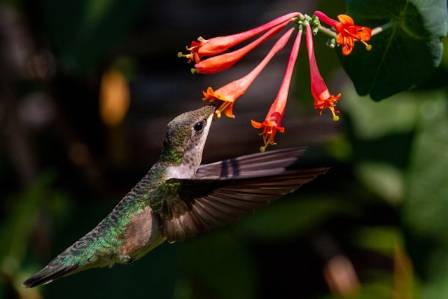
Even among colorful hummingbirds, this species stands out—shimmering green overall, with throats that blaze copper-orange, breasts that glow cobalt-violet, and blue crowns when caught in the right light. Structural feather coloration creates these radiant effects, with no sexual dimorphism or seasonal changes. Found in Costa Rican and Panamanian cloud forests at 1,500–3,200 meters, they are common in protected habitats and tolerate moderate disturbance.
Scarlet Macaw (Ara macao)
An icon of tropical biodiversity, the scarlet macaw has vivid scarlet plumage, yellow wing patches edged in green, and cobalt-blue flight feathers. Males and females are identical, retaining color year-round. They inhabit lowland rainforests from Mexico to South America, forming pairs that preen and fly in synchronized arcs. While globally Least Concern, Central American populations are depleted by habitat loss and pet trade trapping, with reintroduction programs aiding recovery.
Black-Backed Dwarf Kingfisher (Ceyx erithaca)
Asia’s jewel-like kingfisher boasts lilac-rufous crowns, ultramarine-blue backs, chrome-yellow-orange underparts, and coral-red bills. Males are more iridescent than females, and both molt annually with slight brightness reduction. They live in forested areas of the Indian Subcontinent and Southeast Asia, near streams or dry ravines. Vulnerable to habitat fragmentation, their conservation depends on preserving intact forest canopies.
Golden-Breasted Starling (Lamprotornis regius)
One of the world’s most dazzling starlings, it has iridescent green-blue-purple upperparts, golden-yellow underbodies, and long bronzed tails. Males and females are nearly identical, retaining color year-round. Found in East African dry woodlands and savannas, they form small flocks and use upright perching and vocal displays during breeding. Stable and common in protected areas, they face no major threats.
Spangled Cotinga (Cotinga cayana)
The most vivid member of its genus, males have bright turquoise plumage, black wings and tails, and purple throats—with “spangled” feather bases. Females are soft gray-brown. They inhabit Amazon lowland forests, gathering in treetops for display flights and bowing rituals. Widespread in protected areas, Amazonian deforestation is a long-term risk, though populations remain stable.
European Bee-Eater (Merops apiaster)
Europe’s most vibrant bird has chestnut crowns, golden-yellow throats edged in black, turquoise underparts, and red-orange backs. Males are brighter than females, with no dramatic seasonal changes. They breed in European, Asian, and North African open landscapes, migrating to sub-Saharan Africa. Though decreasing in some areas due to agricultural changes, they remain widespread and protected.
Wilson’s Bird-of-Paradise (Diphyllodes respublica)
Extraordinary even among birds-of-paradise, males have emerald breast shields, crimson backs, yellow nape capes, turquoise-blue crowns, and violet tail curls. They retain plumage year-round, performing forest-floor displays to attract females. Endemic to West Papua’s Waigeo and Batanta islands, they are Near Threatened due to deforestation and hunting, with ecotourism initiatives aiding conservation.
Lilac-Breasted Roller (Coracias caudatus)
Africa’s iconic bird has lilac breasts, spring-green crowns, indigo-sky-blue wings, and elongated black tail streamers. Males and females are identical, with no seasonal color shifts. They inhabit eastern and southern African woodlands, performing acrobatic display flights during breeding. Widespread and stable in protected areas, they face no major population threats.
White-Breasted Fruit Dove (Ptilinopus rivoli)
Among the world’s most colorful doves, highland males have green upperparts, white-yellow breast patches, maroon belly spots, and purplish-red foreheads. Females are uniformly green with yellow vents. Found in New Guinea’s forests, they are quiet and inconspicuous, relying on intact forests for food. Locally common, habitat loss could impact fragmented populations.
Knobbed Hornbill (Rhyticeros cassidix)
A striking hornbill, males have rufous crowns, black bodies, yellow bills with red casques, and turquoise throat skin. Females have black heads and smaller yellow casques. Endemic to Sulawesi, they inhabit lowland forests and depend on large fruiting trees for food and nesting. Listed as Vulnerable, deforestation and hunting drive declines, with protection of mature forests critical.
King Vulture (Sarcoramphus papa)
The world’s most visually striking vulture has white body plumage, black flight feathers, and a bare head in orange, red, yellow, and blue. Males and females are similar, with no seasonal changes. Found in Central and South American lowland forests, they use bowing and wing displays during courtship. Widespread but declining due to habitat loss and trophy hunting, they benefit from scattered protections.
The Science of Avian Coloration
Bird coloration arises from evolutionary forces like sexual selection (females choosing bright males), social signaling, and predator defense. Tropical birds often have more vivid plumage due to stable climates and pigment-rich diets, while temperate species favor cryptic colors for camouflage. Bright plumage comes with costs—energetically expensive to maintain and risky for predation—explaining why some species molt into dull “eclipse” plumage post-breeding.
Nature’s Color Toolkit

Three mechanisms create bird colors: carotenoids (diet-derived, producing yellows/oranges/reds), melanins (body-produced, creating blacks/browns/grays and strengthening feathers), and structural coloration (microscopic feather structures scattering light for blues/iridescence). These systems work alone or in combination, with rare genetic mutations (e.g., albinism) adding further diversity.
अगला सहारा

· en
8 Fascinating Sunflower Facts
Asher Wren

· en
Do Old TV Antennas Still Work in the Digital Age?
Henry
· hi
कॉफी और विभिन्न संस्कृतियों में इसकी भूमिका
अंकित

· hi
एल कैपिटन के बारे में 10 तथ्य
नीरज

· hi
अपने वॉर्डरोब को परफेक्ट हैट से स्टाइल करें
ममता बस्नेत

· en
The Indoor Eden: A Complete Guide to Thriving Houseplants
Felix Austin