धीरे-धीरे पढ़ें
8 Types of Orioles to Spot Across the United States
The term “oriole” traces back to a Latin word meaning “the golden one.” Though the name was first given to an unrelated group of birds in Europe, Asia, and Africa, it fits American orioles perfectly. These birds are part of the blackbird family—alongside grackles, red-winged blackbirds, and meadowlarks—and share the family’s characteristic sharply pointed beaks.
Anthony Clarke
रचनाकार
याद रखें
नीचे पूरी रचना पढ़ें और अपने लिए उपयोगी बात चुनें।
अनुभाग
सकारात्मक विचार
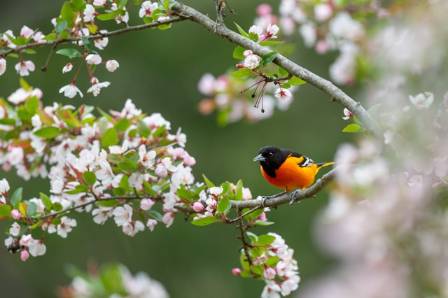
The term “oriole” traces back to a Latin word meaning “the golden one.” Though the name was first given to an unrelated group of birds in Europe, Asia, and Africa, it fits American orioles perfectly. These birds are part of the blackbird family—alongside grackles, red-winged blackbirds, and meadowlarks and share the family’s characteristic sharply pointed beaks.
Eight oriole species are regularly found north of the Mexican border, and during summer, you can spot at least one or two of these species in nearly every region of the United States. In northern areas, male orioles often have brighter, more distinct patterns than females. However, in southern regions, the two sexes of many oriole species look nearly identical.
Female orioles are skilled nest builders. They weave plant fibers into either a cup shape or a hanging pouch, usually suspending the nest near the end of a tree branch. Hidden by leaves, these nests provide a safe cradle for their young, shielding them from most predators.
Below, we’ll explore where and how to identify the oriole species commonly found in the U.S. and Canada.
Baltimore Oriole
As early as the 1720s, residents of the eastern American colonies referred to this bird as the “Baltimore bird.” The male’s bright orange and black plumage resembled the coat of arms of Lord Baltimore, a British nobleman for whom the city of Baltimore, Maryland, was also named. The word “oriole” was added to the bird’s name decades later.
During summer, Baltimore orioles are widespread across most eastern U.S. states and southeastern Canada. In winter, smaller numbers of these birds stay in the southeastern states, where milder weather provides enough food to sustain them.
Bullock’s Oriole
Bullock’s oriole is a close relative of the Baltimore oriole, but it occupies the western half of North America—effectively replacing the Baltimore oriole in that region. Where the two species overlap on the western Great Plains, they often interbreed. The hybrid offspring have appearances that fall between their parent species.
For several years, these two orioles were classified as a single species called the “northern oriole,” but they were later split back into separate species. Bullock’s orioles share similar habits with Baltimore orioles, often building their nests in shade trees in backyards and residential areas.
Orchard Oriole
True to its name, the orchard oriole prefers short trees and semi-open spaces—such as orchards, the edges of woodlands, or suburban areas with scattered trees—rather than the dense interior of tall forests. During summer, this species is widespread in U.S. states east of the Rocky Mountains, though it barely extends into Canada. It’s most common in the southern U.S.
The orchard oriole is the smallest oriole on the continent, measuring just over 7 inches long. Adult males have dark chestnut plumage instead of the orange or yellow seen in other oriole species, while females are a soft yellow-green.
Birdwatchers sometimes struggle to identify 1-year-old male orchard orioles, as they look similar to females but have a black throat. Like adult males, these young males perch on low tree branches to sing rapid, jumbled songs. Even in areas where orchard orioles are abundant, they migrate south early—often leaving by mid-August, well before other oriole species.
Scott’s Oriole
The rich, warbling song of the Scott’s oriole carries far across the foothills of its summer habitat in the American Southwest. This yellow-and-black bird lives in a variety of environments, from juniper or oak woodlands to desert grasslands, but it’s most often found where yucca plants grow.
Yuccas are critical to Scott’s orioles: their long, stiff, pointed leaves provide strong fibers for nest-building. More importantly, the spiny tips of yucca leaves deter most predators, keeping the nests safe. In one study conducted in southern New Mexico, every Scott’s oriole nest discovered was tucked among the leaves of a yucca plant.
Hooded Oriole
During summer, hooded orioles are common across the Southwest, from Texas to California. Males have striking black throats and bright orange “hoods” (the feathers on their heads and upper chests), while females are a plainer yellow.
Female hooded orioles build cup-shaped nests in a variety of trees, including sycamores and cottonwoods, but they show a clear preference for palm trees—especially in California. They pull long, strong fibers from the edges of palm leaves to use as building materials, and nests attached to the undersides of palm leaves stay well-protected from rain, wind, and harsh sunlight.
Audubon’s Oriole
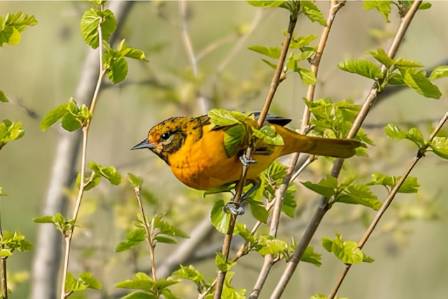
The slow, hesitant calls of Audubon’s orioles—sounding like a child learning to whistle—can reveal their presence in the woodlands of central or southern Texas. Unlike other oriole species, which often perch high in trees, Audubon’s orioles stay fairly low in the canopy and tend to be shy.
Males and females have similar plumage patterns: black heads, wings, and tails that contrast sharply with their yellow body feathers. Females are slightly duller in color than males. Audubon’s orioles are year-round residents of Texas, and pairs are often seen foraging or nesting together.
Altamira Oriole
Many oriole species live in the American tropics, but the Altamira oriole is one that barely reaches the U.S. border. It’s a locally common year-round resident in the Rio Grande Valley of southernmost Texas.
The Altamira oriole is the largest oriole species in the U.S., measuring up to 10 inches from the tip of its bill to the end of its tail. Both males and females have the same bright orange and black plumage. They also build the largest nests of any U.S. oriole: narrow, hanging bags made from woven plant fibers, measuring 1 to 2 feet long. These nests are usually suspended from the tip of a tree branch, and sometimes even from telephone wires.
Spot-Breasted Oriole
Native to Central America, this large oriole was once kept as a cage bird. In the 1940s, a small number of spot-breasted orioles escaped from captivity in Florida and began breeding in the wild. Today, they remain locally common along shady suburban streets from Miami to West Palm Beach.
Males and females have identical bright orange and black plumage, with a key identifying feature: small black spots on the sides of their chests. These spots make them easy to distinguish from other oriole species in Florida.
Expert Tips to Attract Orioles
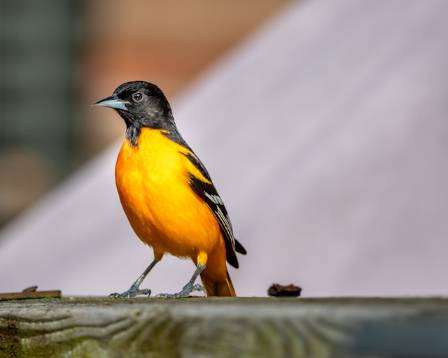
No matter where you live in the U.S., orioles are likely nearby during spring and summer. Keep an eye out for these colorful birds in your backyard or favorite birdwatching spots. In autumn, after the leaves fall, you can still spot their impressive hanging nests clinging to bare branches.
Birding experts the Kaufmans share four simple ways to welcome orioles to your yard:
Plant preferred trees: Grow trees that orioles love for nesting, such as elms and cottonwoods (where local regulations allow), or native palm trees in warmer climates. These trees provide both nesting sites and natural food sources.
Offer fresh oranges: Cut oranges in half and place them on tree branches, feeding platforms, or specialized oriole feeders. Orioles are drawn to the sweet juice.
Use sugar-water feeders: Fill feeders with a sugar-water mixture (four parts water to one part sugar). Choose feeders with convenient perches, as orioles prefer to land while feeding.
Serve grape jelly: Offer small amounts of grape jelly each day. Think of it as a special treat rather than a main meal—too much jelly can be unhealthy. Place the jelly in a shallow dish, ideally near other oriole attractions like orange halves or sugar-water feeders.
अगला सहारा

बकेट लिस्ट: 6 सर्वश्रेष्ठ मोटर रेस आपको व्यक्ति में देखने की जरूरत है
मायरा

The Invisible Perfume Factory Hidden Inside Every Meerkat
Hamilton Adrian
What Big Ears You Have! Serengeti’s Bat-eared Fox
Abigail Foster

अपने बच्चे के साथ कैसे खेलें
निर्भय

A Journey Through Still Life: Famous Fruit Paintings in Art History
Isabella Meyer

आप मिल्की वे को कहाँ देख सकते हैं? – दुनिया की 10 बेहतरीन जगहें
इन्द्रेश